
Dubai Studio Prices Hold Near $177,000 as Launches Shift to Cheaper Areas
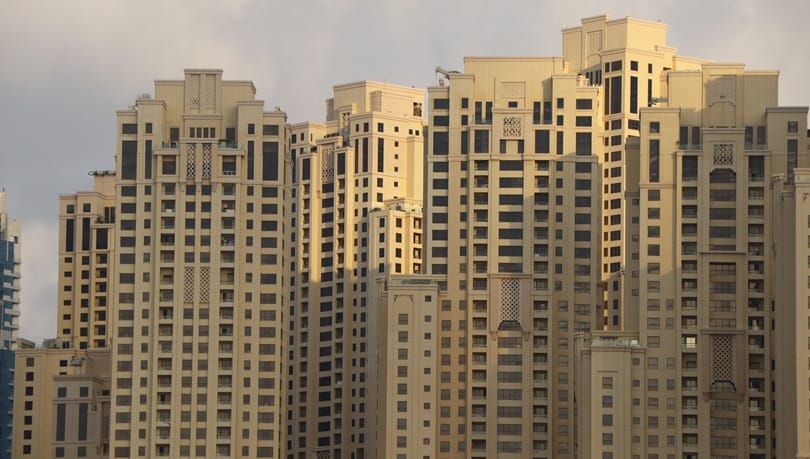
Dubai's off-plan market has maintained an entry price of around $177,000 (AED 650,000) for newly launched studio apartments since 2024, but the apparent stability masks a significant shift toward lower-priced communities, according to a Global Capital Partners (GCP) report reviewed by Al Masdar Al Aqaari.
The report, based on data from REIDIN's project launch tracker, shows that 48% of studio project launches in the first half of 2026 were concentrated in the cheapest third of Dubai's communities, up from 25% two years earlier.
The findings reviewed by Al Masdar Al Aqaari indicate that the shift toward lower-priced communities has helped keep Dubai's headline studio entry price broadly stable, even as developers increased starting prices within comparable locations.
The analysis covers 1,961 residential projects announced in Dubai between January 2024 and June 2026, including 1,691 apartment projects.
Dubai Studio Prices Remain Broadly Stable
The median starting price for a newly launched studio stood at approximately $176,800 (AED 649,000) in the first half of 2026, virtually unchanged from the first half of 2024.
That contrasted with increases across larger apartment types.
The median starting price of a one-bedroom apartment rose 7% over the same period to around $321,500 (AED 1.18 million), while two-bedroom and three-bedroom apartments both recorded increases of 17%, reaching approximately $569,500 (AED 2.09 million) and $956,400 (AED 3.51 million), respectively.
However, the stability in studio prices does not mean developers kept prices unchanged in comparable locations.
The geographic distribution of new studio projects shifted significantly toward cheaper parts of Dubai. The share of studio launches in the cheapest third of communities increased from 25% in the first half of 2024 to 48% in the first half of 2026, after exceeding 50% during 2025.
The figures suggest that a growing share of Dubai's entry-level off-plan studio supply is being introduced in lower-priced locations.
Shift to Cheaper Areas Keeps Studio Entry Prices Lower
A separate comparison of launches in 2024 with those in 2025–26 illustrates the impact of location on headline studio prices.
Within the cheapest third of Dubai communities, the median studio starting price increased from approximately $163,500 (AED 600,000) to $169,000 (AED 620,000).
Across the rest of the market, the median increased from around $191,600 (AED 703,000) to $204,400 (AED 750,000).
At the same time, the cheapest third of communities increased their share of studio launches from 31% in 2024 to 52% in 2025–26.
GCP estimates that if studios launched in 2025–26 had retained the same geographic mix as in 2024, their median starting price would have been approximately $186,600 (AED 685,000) rather than the actual median of around $179,800 (AED 660,000) calculated across the periods used for that comparison.
The findings indicate that Dubai's studio entry price has remained lower partly because more projects are being launched in less expensive communities, rather than solely because developers have restrained price increases.
For buyers, this means the overall amount required to enter Dubai's off-plan apartment market has changed relatively little, but a greater proportion of homes available at that price are now located in lower-priced areas.
Dubai Industrial City Gains Share of Studio Launches
The shift is also evident in the communities attracting the largest number of new studio projects.
Jumeirah Village Circle led Dubai for studio project launches in 2024, with 60 projects. By the first half of 2026, Dubai Industrial City had become the leading location.
Four of the seven leading communities for studio launches in the first half of 2026 were among the cheapest third of Dubai communities for studios, compared with two of the five leading locations in 2024.
Larger apartments followed a markedly different pattern.
The share of three-bedroom launches in the cheapest third of communities fell from 42% in the first half of 2024 to just 19% in the first half of 2026.
One- and two-bedroom apartments — the most common unit types across new launches — showed considerably less movement, with about 44% of launches in each category located in the cheapest third of communities in the first half of 2026.
The figures point to a growing divergence in Dubai's off-plan market, with studios increasingly shifting toward more affordable locations while larger family homes move toward higher-priced communities.
Like-for-Like Prices Reveal a Different Trend
The report also sought to distinguish changes in developers' pricing from movements caused by different projects and communities entering the market.
It compared the same developer, in the same community and for the same unit type, across different periods.
On this like-for-like basis, studio starting prices increased 4.9%, despite the broader market measure showing virtually no change.
The opposite was evident for three-bedroom apartments.
While the market-wide comparison indicated a 20% increase in three-bedroom starting prices between 2024 and 2025–26, the increase narrowed to 9.8% when the same developers and communities were compared.
One- and two-bedroom apartments also recorded smaller price increases on a like-for-like basis than indicated by the broader market figures.
Around two-thirds of developers increased their starting prices across each of the main apartment categories analysed.
The findings highlight how changes in the geographic and development mix of new supply can influence Dubai property price indicators, particularly when launches shift between lower- and higher-priced communities.
Newly Launched Dubai Studios Are Getting Smaller
The changing composition of Dubai's off-plan market is also reflected in apartment sizes.
The median minimum advertised size of a newly launched studio declined 6.9% between the first half of 2024 and the first half of 2026, falling from 408 sq ft to 380 sq ft.
One-bedroom apartments became 3% smaller, with their median minimum size declining from 739 sq ft to 717 sq ft.
Two-bedroom apartments remained broadly unchanged at around 1,160 sq ft, while three-bedroom apartments moved in the opposite direction, increasing 2.4% to 1,820 sq ft.
However, the report cautions against interpreting the studio figures simply as evidence that developers are shrinking comparable apartments. Part of the change reflects the different mix of locations and projects entering the market.
Dubai Studios Carry 12.8% Price-per-Square-Foot Premium
Smaller apartments also tend to command higher prices per square foot within the same development.
Studios were priced 12.8% higher per square foot than one-bedroom apartments in the same project, with studios carrying the higher rate in 90% of the projects analysed.
The premium narrowed significantly as unit sizes increased. One-bedroom apartments were priced 2.3% higher per square foot than two-bedroom units, while two-bedroom apartments were marginally cheaper per square foot than three-bedroom units.
The relationship became more pronounced further up the size range, with three-bedroom apartments priced 7.8% lower per square foot than four-bedroom units within the same projects.
Across the market, 64.7% of apartment projects analysed priced smaller units at a premium per square foot, compared with 48.5% of villa projects.
The findings underline an important distinction for buyers: smaller apartments require a lower overall purchase price but can command a substantially higher rate for each square foot of space.
Dubai Off-Plan Market Becomes More Segmented
Taken together, the data points to an increasingly segmented Dubai off-plan residential market.
Studios are increasingly being launched in lower-priced communities, helping preserve an entry point of around $177,000 (AED 650,000), while three-bedroom apartments have increasingly shifted toward higher-priced locations.
One- and two-bedroom apartments have remained relatively more stable in terms of where new projects are being introduced.
The result is a market where headline prices alone may not fully capture changes in affordability. For entry-level buyers in particular, the amount required to access Dubai's off-plan market has remained broadly stable, but the location and size of the property available at that price have changed.
The report is based on REIDIN's project launch tracker and covers project announcements rather than property transactions. The prices represent developers' advertised starting prices at launch and should not be interpreted as achieved selling prices or evidence that the units were sold.
Related Articles